
Why Teams Forget Critical Information Within 24 Hours of an Incident
Learn how OpsBrief helps teams preserve critical operational context by automatically organizing incidents, deployments, alerts, and infrastructure changes into a searchable timeline..

Andrea Brown

An incident ends. Services recover. Alerts stop firing. Everyone moves on to the next priority. But within hours, something important begins to happen: critical operational context starts to disappear. The details that seemed obvious during the incident become harder to recall. Conversations get buried in chat channels. Decisions made under pressure are forgotten. Important observations never make it into documentation. This is one of the most overlooked challenges in incident management. The longer teams wait to capture operational context, the more information they lose.
Incident Knowledge Fades Faster Than Most Teams Realize
During an active incident, responders are focused on solving problems. Documentation is rarely the top priority. Engineers are investigating alerts, coordinating with teammates, reviewing logs, and implementing fixes. Valuable information is exchanged rapidly across multiple tools and conversations. Once the incident is resolved, teams often assume they can reconstruct everything later. In reality, operational memory fades quickly. Within 24 hours, responders may struggle to remember:
- The sequence of events
- Why specific decisions were made
- Which alerts appeared first
- What hypotheses were investigated
- Which systems were affected initially
Operational Context Gets Lost Across Systems
Modern incident response involves multiple platforms. Discussions happen in Slack or Microsoft Teams. Alerts originate from monitoring tools. Deployments are tracked in GitHub. Escalations occur through PagerDuty. The result is operational information scattered across disconnected systems. When teams later attempt to conduct a postmortem, they are often forced to piece together events manually. This process is time-consuming and frequently incomplete. Without a reliable operational record, valuable lessons can be missed.
Why Missing Context Leads to Repeated Problems
The goal of an incident review is not simply to document what happened. It is to understand why it happened and how similar issues can be prevented in the future. When key details are missing, teams may struggle to identify:
- Contributing factors
- Operational bottlenecks
- Escalation delays
- Process gaps
- Recurring patterns

Incident Timelines Improve Knowledge Retention
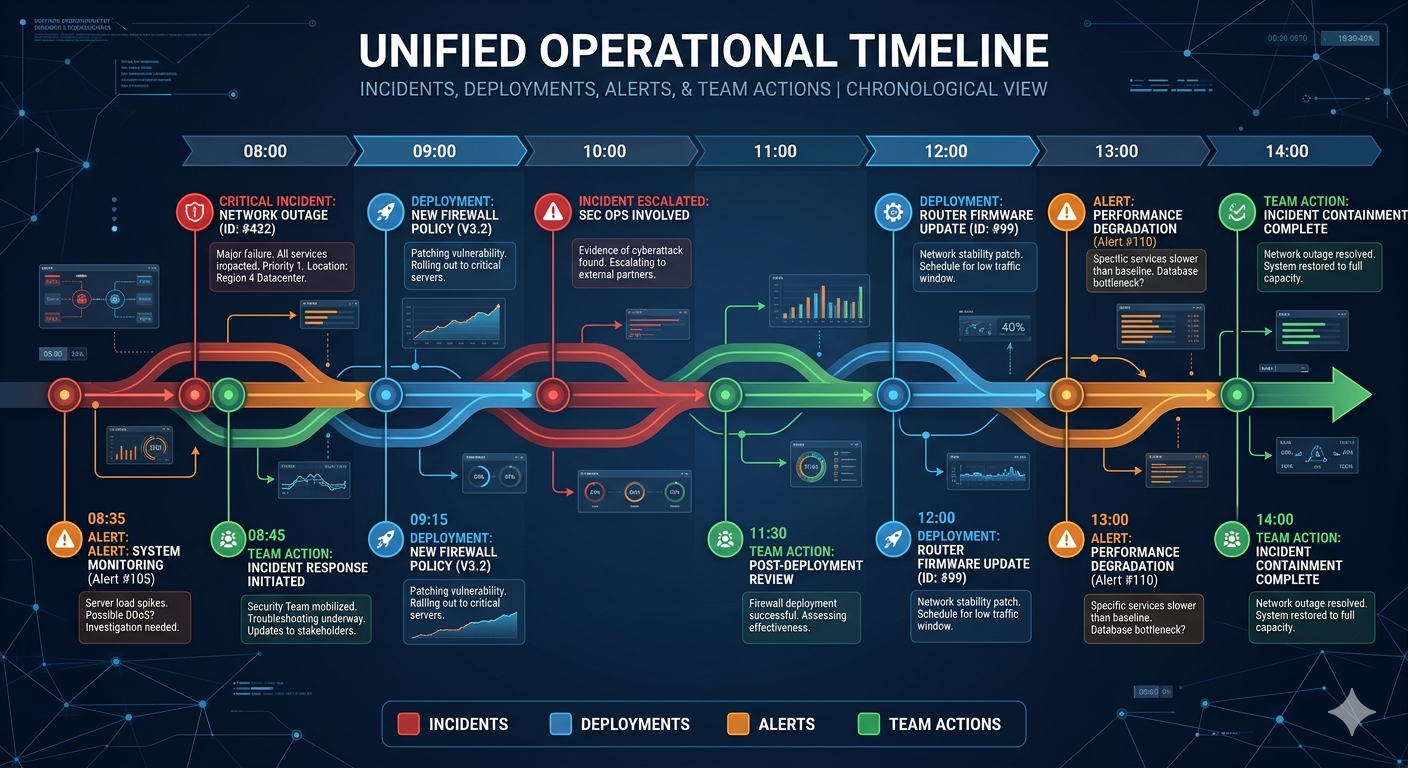
One of the most effective ways to preserve operational knowledge is through structured incident timelines. A clear timeline provides visibility into:
- Alerts and notifications
- Deployments and releases
- Infrastructure changes
- Escalations and responses
- Resolution milestones
Instead of relying on memory, teams can reference a factual record of what occurred during the incident. This creates more accurate postmortems and stronger organizational learning.
Turning Operational Events Into Institutional Knowledge
 High-performing teams treat incidents as opportunities to improve future operations.
OpsBrief helps teams automatically organize operational events from tools like Slack, GitHub, PagerDuty, Datadog, Discord, and Microsoft Teams into a searchable operational timeline.
By preserving context as incidents unfold, teams can review events more accurately, identify recurring patterns, and improve future response efforts without relying solely on memory.
This turns operational activity into a lasting source of organizational knowledge.
High-performing teams treat incidents as opportunities to improve future operations.
OpsBrief helps teams automatically organize operational events from tools like Slack, GitHub, PagerDuty, Datadog, Discord, and Microsoft Teams into a searchable operational timeline.
By preserving context as incidents unfold, teams can review events more accurately, identify recurring patterns, and improve future response efforts without relying solely on memory.
This turns operational activity into a lasting source of organizational knowledge.
Conclusion
Critical incident knowledge begins to fade much sooner than most teams expect.
Without a structured way to capture operational context, important details can disappear within hours, making postmortems less effective and recurring issues harder to prevent.
Teams that preserve operational timelines and maintain visibility across incidents are better equipped to learn from failures, improve response processes, and strengthen operational resilience over time.
Gain Operational Visibility. Request a demo.


