
Why More Dashboards Don’t Improve Incident Response

Jasmine Decker

When incident response slows down, the common assumption is that teams need more visibility. The solution often looks familiar: another dashboard, another monitoring tool, or another reporting layer. But most organizations already have plenty of visibility. The real challenge is that visibility is fragmented. During incidents, teams are rarely lacking data. They're struggling to connect the data they already have. As a result, adding more dashboards often creates more complexity rather than faster resolution.
The problem isn't visibility. It's context.
Modern engineering teams have access to an enormous amount of operational information. Infrastructure metrics. Application monitoring. Deployment logs. Incident alerts. Service health dashboards. Communication channels.
The issue is that this information exists across multiple systems. When an incident occurs, responders are forced to switch between tools to understand what happened. They may need to review:
- Monitoring dashboards
- Deployment histories
- Incident management platforms
- Slack or Microsoft Teams conversations
- Infrastructure change logs
Each system provides part of the story, but none provide the full operational picture.
Dashboard Overload Creates Investigation Delays
Adding more dashboards may increase data availability, but it often increases cognitive load as well. Engineers spend valuable time asking questions like:
- Which dashboard should I check first?
- Is this related to a recent deployment?
- Has another team already identified the issue?
- Are multiple systems affected?
- What changed before the incident started?
Instead of focusing on diagnosis and remediation, responders spend time gathering information. This investigation overhead becomes a significant contributor to MTTR. The more fragmented the information, the longer it takes to build situational awareness.
Why Context Switching Slows Incident Response
One of the biggest hidden costs during incidents is context switching. Every time responders move between dashboards, tools, chats, and logs, they lose momentum. Operational context becomes fragmented across multiple interfaces. This can lead to:
- Slower incident triage
- Missed relationships between events
- Duplicate investigations
- Communication delays
- Increased cognitive fatigue
Even small delays accumulate quickly during high-pressure incidents.
Teams often spend more time reconstructing timelines than resolving the underlying problem.

Effective Operational Visibility Looks Different
High-performing teams don't necessarily have more dashboards. They have better context. Effective operational visibility is not about displaying more information. It's about organizing information in a way that helps teams understand how operational events relate to one another. Responders need answers to questions like:
- What changed recently?
- Which deployment occurred before the incident?
- Are there related alerts or service degradations?
- Who is already involved?
- How are systems connected?
The faster teams can answer these questions, the faster they can move toward resolution.
Building an Operational Visibility Layer
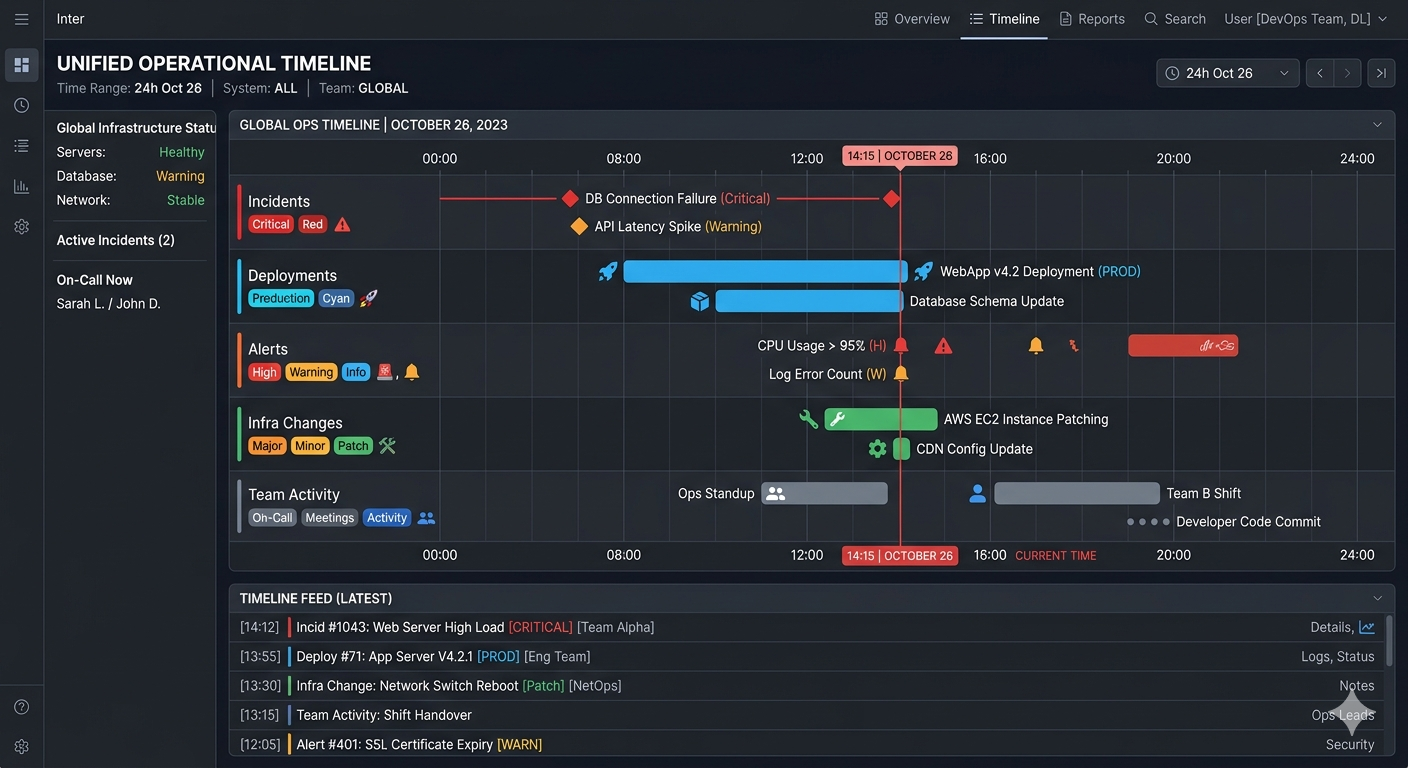 An effective operational visibility layer brings together the events that matter most.
Instead of forcing teams to jump between disconnected dashboards, it creates a shared timeline of operational activity.
OpsBrief helps teams organize information from tools like Slack, GitHub, PagerDuty, Datadog, Discord, and Microsoft Teams into one searchable operational timeline.
By correlating incidents, deployments, alerts, and infrastructure changes, teams gain context without the overhead of managing more dashboards.
This allows responders to focus on understanding and resolving incidents rather than searching for information.
An effective operational visibility layer brings together the events that matter most.
Instead of forcing teams to jump between disconnected dashboards, it creates a shared timeline of operational activity.
OpsBrief helps teams organize information from tools like Slack, GitHub, PagerDuty, Datadog, Discord, and Microsoft Teams into one searchable operational timeline.
By correlating incidents, deployments, alerts, and infrastructure changes, teams gain context without the overhead of managing more dashboards.
This allows responders to focus on understanding and resolving incidents rather than searching for information.
Conclusion
Most organizations don't have a visibility problem.
They have a context problem.
Adding more dashboards rarely improves incident response if teams still need to piece together information from multiple sources.
Operational visibility becomes truly effective when teams can see how events connect, understand what changed, and quickly establish context during incidents.
The goal isn't more dashboards. It's faster operational awareness. Request for a demo.


