
Deployment Risk Scoring: Predicting Incidents Before They Happen
Learn how OpsBrief helps teams correlate deployments, operational events, and incidents to improve visibility into release risk and accelerate incident response.

Rosemary Samuel

Every deployment introduces change. Most releases go smoothly, but even well-tested deployments can produce unexpected behavior once they reach production. That's why deployment success isn't simply about whether code ships successfully. It's about understanding the operational risk that comes with every release. As systems become more distributed and deployment frequency increases, engineering teams need better ways to identify potential issues before they become incidents. This is where deployment risk scoring is becoming increasingly valuable.
What Is Deployment Risk Scoring?
Deployment risk scoring is the practice of evaluating how likely a release is to cause operational issues. Rather than treating every deployment the same, teams assess factors that may increase deployment risk, including:
- Deployment size
- Number of affected services
- Infrastructure changes
- Historical deployment performance
- Service dependencies
- Recent incident history
By identifying high-risk deployments early, teams can apply additional monitoring, validation, or rollout controls before problems reach customers.
Why Every Deployment Doesn't Carry the Same Risk
Not all releases have the same operational impact. A minor UI update typically carries less risk than a deployment affecting authentication services, payment systems, or shared infrastructure. Risk also increases when deployments involve:
- Multiple services
- Database schema changes
- Large configuration updates
- Third-party integrations
- High-traffic production environments
Without visibility into these factors, teams may unknowingly treat low-risk and high-risk deployments exactly the same. That can lead to slower detection when issues arise.
Operational Context Improves Risk Assessment
Deployment risk isn't determined by code changes alone. Operational context matters just as much. For example, a deployment may coincide with:
- Existing service degradation
- Infrastructure maintenance
- Increased customer traffic
- Ongoing incidents
- Recent platform changes
Looking at deployments in isolation makes it difficult to understand their true operational impact.
Teams make better decisions when release activity is viewed alongside the operational events occurring across the environment.

Predicting Problems Before They Escalate
Deployment risk scoring isn't about predicting every incident with certainty. It's about helping teams recognize conditions that deserve closer attention. When engineering teams can identify potentially risky deployments before they affect production, they can:
- Increase monitoring during rollout
- Delay non-critical releases
- Improve rollback readiness
- Coordinate across affected teams
- Reduce investigation time if issues occur
The result is greater operational confidence without slowing delivery.
Building Smarter Deployment Visibility
 High-performing teams don't rely solely on deployment status to measure release success.
They understand how deployments relate to the broader operational environment.
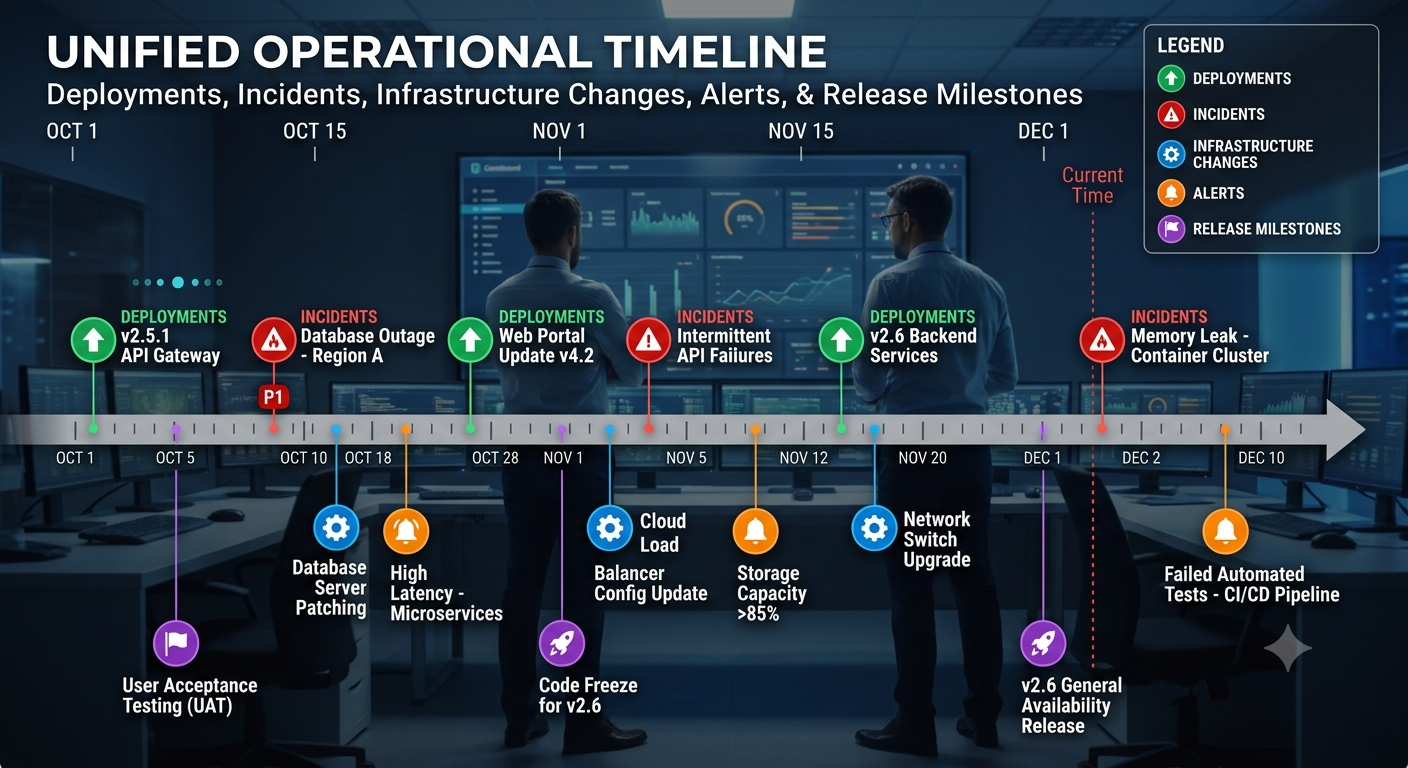
OpsBrief helps teams organize deployments, incidents, infrastructure changes, alerts, and operational events from tools like GitHub, PagerDuty, Slack, Datadog, Discord, and Microsoft Teams into a searchable operational timeline.
High-performing teams don't rely solely on deployment status to measure release success.
They understand how deployments relate to the broader operational environment.
OpsBrief helps teams organize deployments, incidents, infrastructure changes, alerts, and operational events from tools like GitHub, PagerDuty, Slack, Datadog, Discord, and Microsoft Teams into a searchable operational timeline.
By providing the context around every release, teams can better identify operational risk, investigate issues faster, and understand how deployments influence system reliability.
Conclusion
Every deployment carries some level of operational risk, but not every deployment carries the same level of risk.
Organizations that evaluate deployments within the context of operational activity are better positioned to detect issues early, improve release confidence, and reduce the likelihood of production incidents.
Deployment risk scoring isn't about slowing innovation. It's about giving teams the visibility they need to deliver changes with greater confidence.
Gain Operational Visibility. Request for a demo.


