
The First 10 Minutes of an Incident: Why They Determine Everything
Learn how OpsBrief helps teams make the first minutes of an incident count by bringing alerts, deployments, incidents, and operational events into one searchable timeline.

Jake Davids

Every incident has a critical window. It's the period between the first signal that something is wrong and the moment the team understands what's happening. In many cases, that window lasts only a few minutes, but it often determines how the rest of the incident unfolds. If responders gain the right context early, they can investigate with confidence and coordinate effectively. If they don't, valuable time is lost searching for information instead of resolving the issue. That's why the first 10 minutes of an incident often have the greatest impact on Mean Time to Resolution (MTTR).
The Clock Starts Before Anyone Begins Fixing the Problem
When an alert is triggered, the immediate goal isn't to solve the issue; it's to understand it. Responders need answers to questions like:
- What changed?
- Which services are affected?
- Did a deployment happen recently?
- Is this linked to another ongoing incident?
- Who should be involved?
Without quick answers, teams spend the first part of an incident gathering context rather than taking action. Those early delays often ripple through the entire response process.
Context Switching Is the First Bottleneck
Modern engineering teams rely on multiple operational tools.
Monitoring platforms detect issues. GitHub records deployments. PagerDuty manages escalations. Slack or Microsoft Teams capture conversations.
Each platform contributes valuable information, but responders must often switch between them to reconstruct what happened.
Every context switch adds friction.
Instead of forming a clear picture immediately, teams piece together events from disconnected sources while the incident continues to evolve.

Shared Context Speeds Up Decision-Making
The fastest incident response teams aren't necessarily the ones with the most sophisticated monitoring. They're the ones that can establish shared context quickly. When everyone works from the same operational timeline, they spend less time asking:
- Has anyone investigated this already?
- Was there a release today?
- Are these alerts connected?
- Which systems changed?
Instead, they can focus on diagnosis, coordination, and resolution. Shared operational awareness also improves communication across engineering, product, and operations teams, reducing duplicate work during high-pressure situations.
Faster Investigations Lead to Lower MTTR
The quality of the first investigation often determines the efficiency of the entire response. Teams that identify relationships between deployments, infrastructure changes, service degradations, and incidents early are better positioned to:
- Escalate issues appropriately
- Identify root causes sooner
- Avoid unnecessary troubleshooting
- Coordinate responses across teams
- Restore services more quickly
[Reducing MTTR isn't always about solving problems faster.}(/blog/how-to-reduce-mttr-a-complete-guide-to-cutting-incident-response-time-by-70-percent)
It's often about understanding problems sooner.
Building Better Operational Awareness
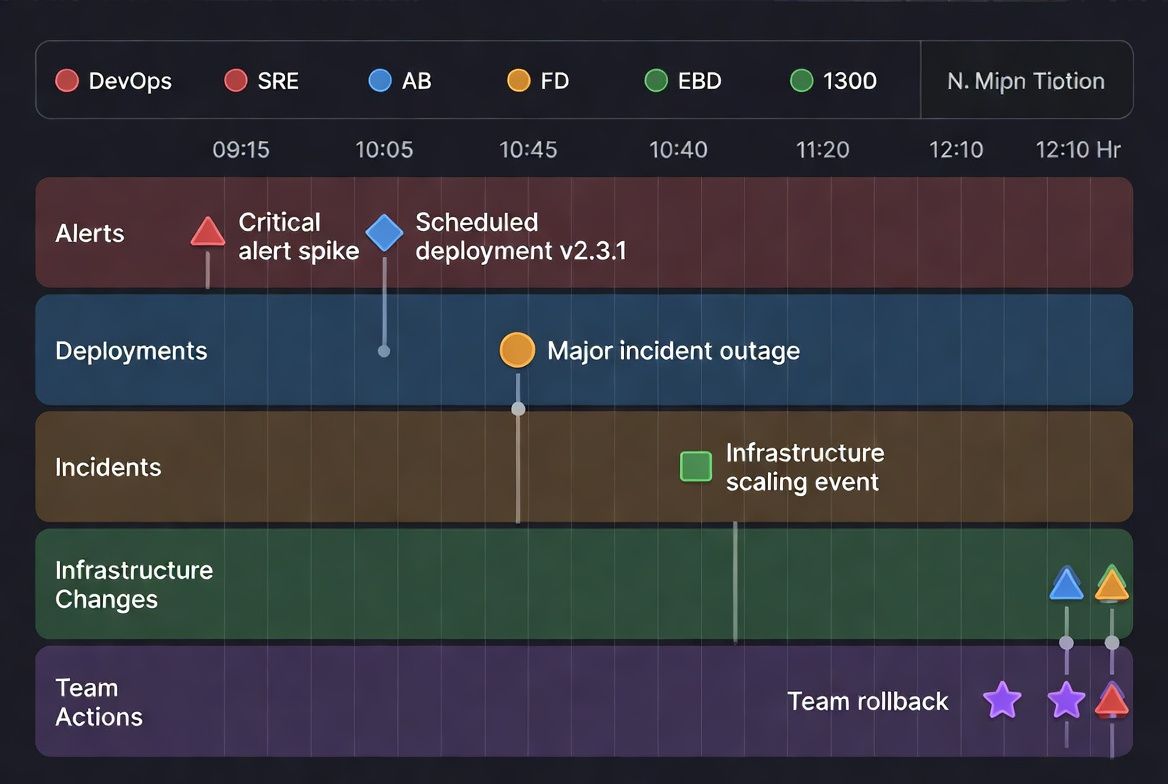
OpsBrief helps teams organize operational activity from tools like Slack, GitHub, PagerDuty, Datadog, Discord, and Microsoft Teams into a centralized operational timeline. Instead of searching across disconnected systems during the opening minutes of an incident, responders can immediately see how alerts, deployments, infrastructure changes, and ongoing investigations relate to one another. That shared operational context enables faster decisions when every minute matters.
Conclusion
The first 10 minutes of an incident rarely determine the technical fix. They determine how quickly teams understand the problem. Organizations that improve operational visibility during those critical early moments reduce confusion, strengthen coordination, and create the conditions for faster incident resolution. When responders begin with context instead of uncertainty, every step that follows becomes more effective.


